 how-to
Who Must Register a Drug Facility With the FDA?
Last Updated: October 28, 2026
Quick Summary
Any establishment that manufactures, repacks, relabels, salvages, or contract-manufactures drugs for the U.S. market must complete drug facility registration with the FDA under 21 CFR Part 207, and most small operations are not exempt. Foreign establishments must also name a U.S. Agent, and registration must be renewed annually.
- Map every activity your facility performs to the registration triggers in 21 CFR Part 207.
- The FDA uses your DUNS number as the unique facility identifier, so request it early.
- Registration and listing are separate obligations; list each drug product and assign NDC numbers.
- A foreign establishment's registration is incomplete without a designated U.S. Agent.
- Renewal follows a fixed calendar window, not your original submission date.
Table of Contents
- Who Has to Register a Drug Facility With the FDA
- FDA Drug Establishment Registration: Covered Activities and Exemptions
- What You Need Before You Register: DUNS, Labeler Code, and U.S. Agent
- How to Register a Drug Establishment With the FDA, Step by Step
- FDA Drug Listing Requirements and NDC Numbers
- FDA Drug Facility Registration Renewal: Deadlines and Updates
- Checking the FDA Drug Establishments Current Registration Site
- Get Your Drug Facility Registration Handled by FDA Agent Pro
- Frequently Asked Questions
Who Has to Register a Drug Facility With the FDA
This guide covers who must register, what you need, and how the process works.
Domestic vs. Foreign Establishments
The U.S. Agent is the FDA's point of contact for a foreign facility (the FDA). Without one, the registration is incomplete.
FDA Drug Establishment Registration: Covered Activities and Exemptions
Some facilities are exempt. A common mistake is assuming a small operation falls outside the rule. It usually does not.
Contract Manufacturers, Repackagers, and Relabelers
Watch out: a repackager that registers but skips product listing leaves a gap the FDA can flag during an inspection.
What You Need Before You Register: DUNS, Labeler Code, and U.S. Agent
For a closer look at how the DUNS number fits into FDA registration, see our guide to DUNS number FDA registration.
How to Register a Drug Establishment With the FDA, Step by Step
- Confirm your registration obligation against 21 CFR Part 207. Before you touch the portal, map every activity your facility performs, manufacturing, API production, repacking, relabeling, salvaging, contract manufacturing, to the registration triggers in Part 207. Each establishment and activity must be captured, and this is the point to confirm whether any operation qualifies for an exemption; most small operations do not.
- Obtain your DUNS number from Dun & Bradstreet. The FDA uses the DUNS number as the unique facility identifier. Request it early, Dun & Bradstreet processing is the most common source of delay. Verify that the legal name and physical address on the DUNS record match your corporate records exactly; a mismatch will surface later as a registration inconsistency.
- Request your labeler code from the FDA. The labeler code identifies the firm that markets the product and is the first segment of every National Drug Code (NDC). You cannot assign NDCs without it. If your firm already holds a labeler code, confirm it is still active rather than requesting a duplicate.
- Create your FDA account and set up facility access. Set up the account under the correct organizational identity and add the users who will submit and maintain records. Keep credentials under firm control, a departed employee with account access is a compliance risk.
- Enter facility information. Provide the establishment name, physical address, contact details, and the specific activities performed there. Enter the DUNS number exactly as issued. Do not use a P.O. box or virtual office as the physical address; the FDA expects the location where the regulated activity occurs.
- Name your U.S. Agent if you are a foreign establishment. A foreign establishment must designate a U.S. Agent, a person or firm physically located in the United States who receives FDA correspondence on the facility's behalf. The registration is incomplete without it, and the agent's details must stay current.
- Submit the registration and save your confirmation. The system issues a confirmation when the submission is accepted. Save it and record the date, it is your evidence of timely registration if the FDA or a commercial partner asks.
- List your drug products and assign NDC numbers. Registration and listing are separate obligations. Once registered, list each drug product, tie it to the registered facility, and assign the NDC built from the labeler code, product code, and package code. Listing records must reflect labeling, package size, and marketing status.
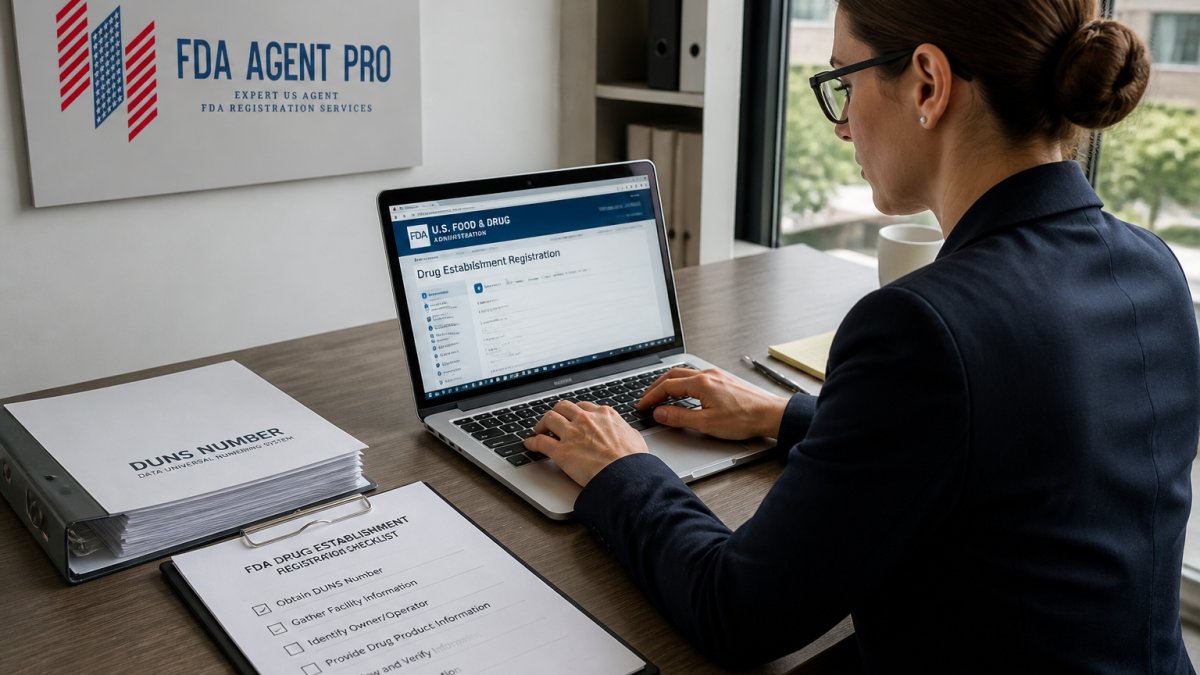
If you want to see exactly what a registration service covers before you start, review the drug establishment registration scope of services.
What to Have Ready Before You Open the Portal
Gather these before step 4:
- Legal entity name and any trade names used on labeling
- Physical address of the establishment and a separate mailing address if different
- DUNS number, verified against your corporate records
- Labeler code (or confirmation that a request is pending)
- Names and titles of the officials responsible for regulatory correspondence
- U.S. Agent name, address, and contact details (foreign establishments)
- A list of every activity performed at the location, mapped to Part 207
- For listing: product names, dosage forms, strengths, package configurations, and labeling
Where Submissions Commonly Stall
A few failure patterns account for most delays:
- DUNS mismatch. The legal name or address on the DUNS record differs from what you enter in the portal. Resolve it with Dun & Bradstreet before resubmitting.
- Missing U.S. Agent. A foreign establishment submits without a designated agent, and the registration is treated as incomplete.
- Registration without listing. The facility is registered but products are never listed, leaving a gap the FDA can flag during an inspection.
- Activity under-description. The facility registers for manufacturing but omits repacking or relabeling performed at the same site.
- Account access problems. The person who set up the account has left, and no one else can update the record.
After You Submit: Verification and Troubleshooting
For more on searching the database, read our post on the Drug Establishment Registration Search.
Here is the registration sequence the article lays out, from confirming your obligation to listing products.
| Step | What to do | Key detail |
|---|---|---|
| 1 | Confirm obligation against 21 CFR Part 207 | Map every activity; most small operations are not exempt |
| 2 | Obtain DUNS number from Dun & Bradstreet | Used as unique facility identifier; common source of delay |
| 3 | Request labeler code from the FDA | First segment of every NDC |
| 4 | Create FDA account and set up facility access | Keep credentials under firm control |
| 5 | Enter facility information | No P.O. box or virtual office as physical address |
| 6 | Name U.S. Agent if foreign establishment | Registration incomplete without it |
| 7 | Submit registration and save confirmation | Record the date as evidence of timely registration |
| 8 | List drug products and assign NDC numbers | Registration and listing are separate obligations |
FDA Drug Listing Requirements and NDC Numbers
For help with listing and NDC numbers, see our FDA OTC drug listing service.
FDA Drug Facility Registration Renewal: Deadlines and Updates
Registration is not a one-time task. Under 21 CFR Part 207, drug establishment registration must be renewed annually, and the renewal window follows a fixed calendar cycle rather than your original submission date. Miss it and your registration lapses, the FDA does not send a personalized reminder, so the obligation to renew sits with you.
How the Annual Renewal Cycle Works
- The window is calendar-based, not anniversary-based. Your renewal is due during the FDA's annual window regardless of when you first registered, a facility that registered in March renews when the window opens, not in March.
- Renewal is a confirmation, not a re-registration. You review the existing record, update anything that has changed, and confirm it. The DUNS number and facility identity carry forward.
- Listing records are maintained separately. Product listing information must also be kept current, and the annual cycle is the natural point to reconcile listing records against what you actually market.
- Foreign establishments must reconfirm the U.S. Agent. The agent designation is part of the registration and must remain accurate through each renewal.
Updates Required Between Renewals
A change in ownership is the one most often mishandled. A new owner that assumes the prior registration is valid without updating the record can find the facility registered under an entity that no longer exists.
What Happens When a Registration Lapses
A lapsed registration has practical consequences:
- Shipment holds. A facility that cannot show a current registration can see shipments held at the border while the record is sorted out.
- Commercial partner friction. Importers, distributors, and contract partners routinely verify registration status before doing business; a lapse can pause those relationships.
- Inspection exposure. An unregistered or lapsed facility that is nonetheless handling drugs for the U.S. market is exposed during an FDA inspection.
- Listing complications. Product listings tied to a lapsed establishment become difficult to maintain, and reinstatement takes longer than timely renewal would have.
Reinstating After a Lapse
If a registration has lapsed, bring the record current quickly: confirm the establishment details, correct stale information (especially DUNS data and the U.S. Agent), and complete the renewal. Expect to explain the gap if asked, and note that the longer the lapse, the more reconciliation the listing records will need.
A Practical Renewal Checklist
For help keeping registration and listing current across cycles, see our FDA drug establishment registration services.
Checking the FDA Drug Establishments Current Registration Site
For more on searching the database, read our post on the Drug Establishment Registration Search.
Get Your Drug Facility Registration Handled by FDA Agent Pro
FDA Agent Pro provides U.S. FDA agent and registration services for foreign companies. FDA Agent Pro provides support for NDA, ANDA, and IND applicants, manages renewal periods, and guides controlled correspondence with the FDA. Over 1,000 companies trust FDA Agent Pro.
FDA drug establishment registration services are one conversation away.
Frequently Asked Questions
Who must register a drug manufacturing facility with the FDA?
Under 21 CFR Part 207, any establishment that manufactures, repacks, relabels, or salvages a drug for the U.S. market must register with the FDA, including foreign facilities that ship here. That covers contract manufacturing organizations, API producers, and repackagers, not just brand owners. Private label distributors who only market the product generally do not register as establishments, but they do need to list the product and hold a labeler code.
How often must drug establishments renew their FDA registration?
Drug establishment registration must be renewed every year, between October 1 and December 31, with the registration staying active through the following calendar year. FDA drug facility registration renewal is not automatic: if you miss the window, your registration lapses and your products can be treated as unregistered at import. Changes to ownership, address, or the type of operations must be reported within 30 days rather than waiting for renewal.
Do drug manufacturers need to list their products with the FDA?
Yes. FDA drug listing requirements mean every commercial drug product must be listed with the FDA, and the listing must be updated in June and December each year and whenever product information changes. Each listing needs an NDC number built from your labeler code. Registration and listing are separate obligations: registering the facility does not list the product, and a missing listing is one of the most common reasons shipments get held.
Can a third-party service register a drug facility with the FDA?
Yes. A registration agent can prepare and submit the establishment registration, manage the product listings and NDC numbers, and act as your U.S. Agent if you are a foreign facility. The FDA still holds your firm responsible for accuracy, so confirm the service verifies your facility details and handles annual renewal and change reporting. Ask what happens after submission, including how quickly they respond to FDA correspondence.
The FDA's registration rules reward preparation and punish guesswork. If you are ready to hand off the paperwork and the deadlines, our team is ready to take them.