 how-to
FDA Agent Response to Inspection Notices
Last Updated: October 23, 2026
Quick Summary
FDA agent response to inspection notices requires speed, accuracy, and clear documentation within specific deadlines: 15 working days for Form 483 observations and 10 business days for warning letters. A missed deadline or inadequate response can trigger enforcement action including product seizure or import refusal.
- Form 483 responses must include a corrective and preventive action plan with five components: root cause analysis, corrective action, preventive action, objective evidence, and timeline.
- The 15-day response deadline for Form 483 observations counts only business days starting the day you receive the notice; weekends and federal holidays do not count.
- Objective evidence such as updated procedures, training records, calibration certificates, and validation reports is required to prove corrections are complete, not just promised.
- Missing the response deadline is treated as an inadequate response and often triggers a warning letter or enforcement action like product seizure.
- As the registered agent, your responsibilities include receiving notices, calculating deadlines, coordinating with facility leadership, drafting responses, and managing FDA correspondence records.
Table of Contents
- Understanding FDA Inspection Notices and Your Role as an Agent
- Responding to FDA Form 483 Observations
- Crafting an Effective FDA Inspection Response Letter
- Handling FDA Warning Letter Responses
- FDA Inspection Preparation Checklist for Agents
- Decision Tree: Identifying Notice Type and Required Action
- Communicating with the FDA: Timelines and Submission
- Common Mistakes Agents Make When Responding to Inspection Notices
- Frequently Asked Questions
Understanding FDA Inspection Notices and Your Role as an Agent
When the FDA issues an inspection notice, your FDA agent response to inspection notices determines whether your establishment stays compliant or faces enforcement action.
FDA agent response to inspection notices requires speed, accuracy, and clear documentation. A missed deadline or inadequate response can trigger warning letters, product detention, or import refusals.
Types of FDA inspection notices
The FDA sends three primary notice types, each requiring a different response strategy.
Inspection Request (Form FDA 482) arrives when an investigator begins an on-site inspection. It's not a violation notice.
Form FDA 483 (Observations) is issued at the end of an inspection.
Warning Letter is the most serious: the FDA found significant violations and is giving you a chance to respond before enforcement action like product seizure or import refusal.
Agent responsibilities versus facility responsibilities
You're the registered agent, the official point of contact for FDA correspondence. The facility operates the business and must implement corrections.
Your responsibilities include:
- Receiving and logging all FDA notices
- Calculating response deadlines
- Coordinating with facility leadership on corrective actions
The facility's responsibilities include:
- Investigating root causes of violations
- Implementing corrective and preventive actions
- Gathering objective evidence of corrections
Responding to FDA Form 483 Observations
Form 483 observations are deficiencies that become violations if you don't address them. The FDA gives you 15 working days to respond.
What Form 483 observations mean
Observations describe what the investigator saw that doesn't match FDA expectations, such as missing batch records, unvalidated equipment, or procedures not followed.
Observations are not automatically violations. They become violations if:
- You don't respond within the deadline
- Your response is incomplete or inadequate
- You don't provide objective evidence of correction
15 working days: calculating your response deadline
The 15-day clock starts the day you receive Form 483. Count only business days; weekends and federal holidays don't count.
How to calculate:
- Day 1 = day you receive the notice
- Count 15 business days forward
- Mark the deadline on your calendar
If 15 days isn't enough, request an extension in writing before the deadline, explain why, and propose a new deadline. The FDA rarely denies such requests.
Building a corrective and preventive action plan
A strong CAPA has five parts:
1. Root cause analysis. Why did the violation occur, training gap, equipment failure, procedure not followed, or system breakdown? Identify the actual cause, not the symptom.
2. Corrective action. What immediate action fixes the specific observation?
3. Preventive action. What longer-term process or system change prevents recurrence?
4. Objective evidence. What documents, records, or test results prove the corrective action is complete?
5. Timeline. When will each action be complete? Give specific dates, not vague timeframes.
Crafting an Effective FDA Inspection Response Letter
Your response letter is a formal document. The FDA will read it to decide whether to accept your response or escalate to a warning letter.
Structure and tone of a compliant response
Start with your facility's name and registration number, the date you received Form 483, and the inspection date.
Structure your response with one section per observation. For each observation, include:
- A restatement of the observation in your own words
- Your root cause analysis
- Your corrective and preventive action plan
Keep sentences short and clear, use active voice, and avoid jargon. Don't make excuses or blame employees or external factors, focus on the fix.
Example opening: "We received Form FDA 483 on [date] following the inspection on [date].
Providing objective evidence and supporting documentation
Objective evidence is the most important part of your response: it proves you've actually corrected the deficiency, not just promised to.
Types of objective evidence include:
- Updated written procedures with implementation dates
- Training records showing employees completed new training
- Equipment calibration certificates dated after the observation
Attach all evidence, number each attachment, and reference it in the text: "See Attachment 3: Equipment Calibration Certificate." Send copies, not originals. Evidence must be dated after the observation; anything dated before the inspection doesn't prove correction.
Handling FDA Warning Letter Responses
A warning letter means the FDA found serious violations and believes you haven't adequately corrected them. It requires a more urgent, detailed response than a Form 483.
Escalation: when Form 483 becomes a warning letter
The FDA issues a warning letter when:
- Your Form 483 response was inadequate or incomplete
- The same observations appear in a follow-up inspection
- The violations are serious enough to warrant immediate enforcement
A warning letter is a final warning before seizure or import refusal, signaling the FDA is considering stronger measures.
Enforcement action risks and response urgency
Once you receive a warning letter, you typically have 10 business days to respond (check the letter for the specific deadline; some give 15 days).
Enforcement actions that can follow a warning letter include:
- Import detention or refusal
- Product seizure
- Injunction to stop manufacturing
Your warning letter response must be more comprehensive than a Form 483 response, including evidence that corrective actions are working.
FDA Inspection Preparation Checklist for Agents
Preparation prevents violations. Before an inspection, make sure your facility is ready.
Pre-inspection readiness for your regulated establishment
Work with facility leadership to conduct an internal audit 30 days before the inspection window, or annually if no inspection is scheduled.
Check these areas:
- Written procedures are current and followed
- Training records are complete and up to date
- Equipment is validated and calibrated
Have a designated inspection coordinator to meet the FDA investigator, arrange facility tours, and gather requested documents.
Documentation and communication protocols
Establish a protocol for when the FDA arrives.
Assign one knowledgeable person to accompany the investigator throughout the facility. Don't let the investigator wander alone.
Provide requested documents promptly; if you don't have one, say so clearly and explain why. Take notes on what the investigator asks, inspects, and requests, this helps you prepare your response.
Decision Tree: Identifying Notice Type and Required Action
Not every FDA notice requires the same response. Use this decision tree to identify what you received and what to do.
Inspection notice versus inspection request
Did you receive a document titled "Inspection Request" or "Form FDA 482"?
If yes: An inspection is about to start or is underway.
If no: Move to the next question.
Did you receive a document titled "Observations" or "Form FDA 483"?
If yes: Respond within 15 working days with corrective and preventive actions backed by objective evidence.
If no: Move to the next question.
Did you receive a document titled "Warning Letter"?
If no: You received a different notice type.
Mapping findings to compliance status and next steps
Each notice type maps to a compliance status:
| Notice Type | Compliance Status | Next Step |
|---|---|---|
| Inspection Request | Under review | Cooperate with investigator |
| Form 483 | Observations identified | Submit corrective action plan within 15 working days |
| Warning Letter | Serious violations found | Submit comprehensive response within 10 business days |
After you submit your response, the FDA will review it. Possible outcomes:
- Accepted: Your response is adequate. No further action unless a follow-up inspection finds new violations.
- Inadequate: The FDA will request additional information or escalate to enforcement.
- Follow-up inspection: The FDA sends an investigator to verify your corrective actions are working.
FDA Agent Pro helps regulated establishments navigate this process. We coordinate with your facility, calculate response deadlines, and draft professional responses backed by objective evidence. Our team has managed inspections for over 1,000 companies.
Communicating with the FDA: Timelines and Submission
Timing and submission method matter. Submit your response on time using the correct method.
Response deadlines and extension requests
Form 483 responses are due 15 working days after receipt; warning letter responses are typically due 10 business days after receipt (check the letter for the specific deadline). Count only business days.
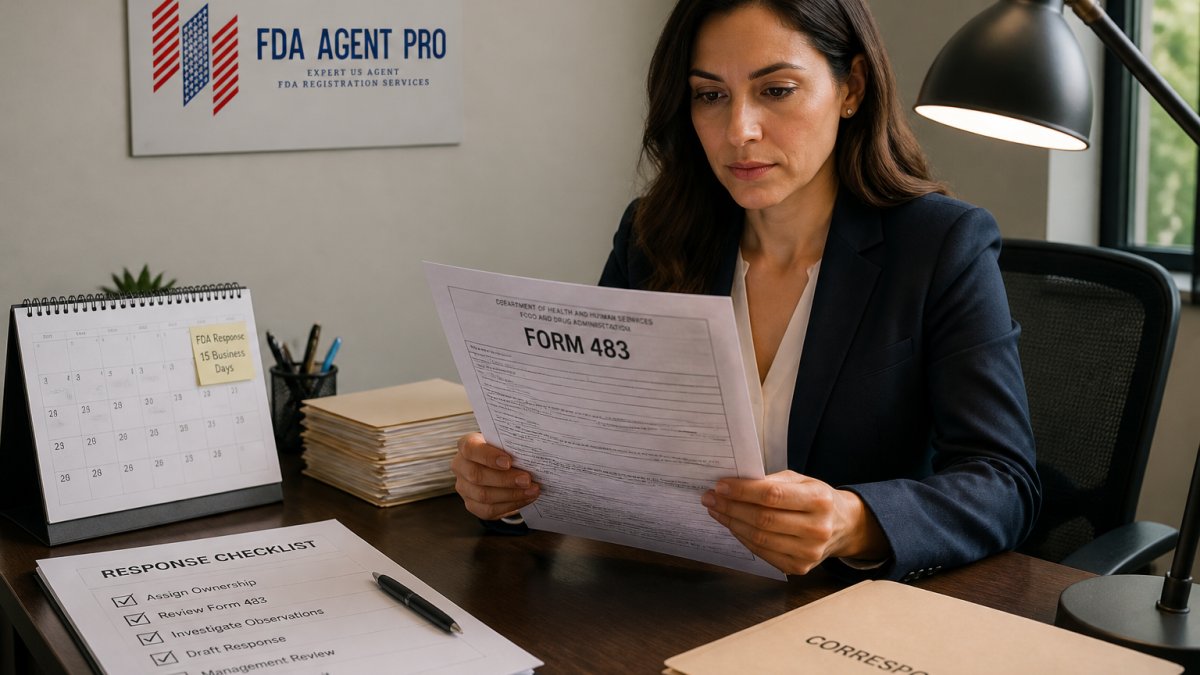
If you need more time, request an extension in writing before the deadline, including your facility's name and registration number, the date you received the notice, the original deadline, your requested new deadline, and a brief explanation.
Submission logistics and records management
Submit your response letter and supporting documentation by certified mail or email. Check the notice for the preferred method and address.
After you submit, the FDA will review your response. You may not hear back for several weeks. If the FDA requests additional information, respond within the timeframe they specify.
Common Mistakes Agents Make When Responding to Inspection Notices
Learning from others' mistakes helps you avoid them.
Inadequate responses and repeat observations
The most common mistake is a response that doesn't fully address the observation, prompting a follow-up notice that your response was inadequate.
Signs of an inadequate response:
- You describe what you're doing but don't provide objective evidence
- You explain the root cause but don't describe the corrective action
- You promise future action instead of describing completed action
Inadequate responses often trigger warning letters, which the FDA treats as a lack of commitment to compliance. Before submitting, have someone outside the facility review your response: is the fix clear, is the objective evidence visible, is the timeline clear?
Missing deadlines and escalation consequences
The second most common mistake is missing the response deadline, which is treated as an inadequate response and often triggers a warning letter.
A missed deadline or inadequate response can escalate to:
- Warning letter
- Import detention or refusal
- Product seizure
These escalations cost time and money and damage your facility's reputation with the FDA.
Responding to an FDA inspection notice requires coordination, accuracy, and speed.
FDA Agent Pro specializes in managing FDA correspondence and inspection responses for regulated establishments.
Frequently Asked Questions
What is the difference between an FDA inspection notice and an inspection request?
An inspection notice is a formal announcement that the FDA will conduct a field inspection at your facility on a specified date. An inspection request is less formal and may indicate the FDA is gathering information or seeking voluntary compliance before scheduling a full inspection. As an FDA agent, you need to distinguish between these to determine the urgency and scope of preparation required. An inspection notice triggers immediate readiness protocols, while an inspection request allows more time to coordinate with the regulated establishment.
How do you calculate the 15 working days deadline for FDA Form 483 response?
The 15 working days begins the day after you receive Form 483 observations. Count only business days (Monday-Friday), excluding federal holidays. If day 15 falls on a weekend or federal holiday, your deadline extends to the next business day. Document the receipt date and maintain a calendar to track the deadline precisely. Missing this deadline signals to the FDA that your facility may not prioritize compliance and can trigger escalation to a warning letter or enforcement action.
What should an FDA inspection response letter include to satisfy regulatory expectations?
Your response letter must address each Form 483 observation individually, explain the root cause of each violation, describe corrective actions taken or planned, provide objective evidence (test results, photos, procedure updates), and include a timeline for completion of any ongoing corrections. The letter should be professional, factual, and avoid defensive language. Include references to your quality system and regulatory procedures that prevent recurrence. Attach supporting documentation such as batch records, training logs, or facility photographs to demonstrate compliance.
What happens if a company does not respond to an FDA warning letter?
Failure to respond to a warning letter within the FDA's specified timeframe (typically 15 working days) can result in enforcement action, including product seizure, facility shutdown, or import detention. The FDA may escalate to civil or criminal prosecution depending on the severity of violations. As an FDA agent, non-response puts your regulated establishment at serious regulatory and financial risk. Timely, comprehensive responses demonstrate good faith compliance and reduce the likelihood of further enforcement action.