 ultimate-guide
FDA Compliance Guidance for Foreign Exporters
Table of Contents
- FDA Compliance Guidance for Foreign Exporters: What the Rules Actually Require
- FDA Foreign Facility Registration and the Unique Facility Identifier
- FDA Import Requirements for Food: Prior Notice, FSVP, and Preventive Controls
- Assigning Responsibilities: Exporter, Importer, Broker, and U.S. Agent
- Your FDA Import Compliance Checklist, Stage by Stage
- Labeling, Packaging, and Product-Specific Requirements
- FDA Export Certificates: Certificate to Foreign Government and Certificate of Free Sale
- When a Shipment Is Detained, Refused, or Missing Documents
- Frequently Asked Questions
Last Updated: October 21, 2026
FDA Compliance Guidance for Foreign Exporters: What the Rules Actually Require
FDA compliance guidance for foreign exporters is the set of registration, notification, verification, and documentation obligations a non-U.S. manufacturer must satisfy before its products can legally enter the United States.
The core tension most exporters miss: the FDA regulates the product's path, not just the product. A good product from a compliant factory can still be refused because a form was filed late or a U.S. agent went silent.
FDA Foreign Facility Registration and the Unique Facility Identifier
FDA foreign facility registration is the mandatory enrollment of your manufacturing or processing establishment with the agency before products ship to the U.S. Each registration must carry a Unique Facility Identifier, which for most food facilities is a Dun & Bradstreet D-U-N-S number.
The registration must name a U.S. agent, a person physically located in the United States who receives FDA communications on your behalf.
Who must register, and how biennial renewal works
Food facilities that manufacture, process, pack, or hold food for U.S. consumption must register, with narrow exemptions for certain small operations and farms.
The FDA publishes the current renewal window and update deadlines on its own site, and the dates are worth checking each cycle rather than assuming last cycle's schedule. See the FDA food facility registration guidance for the authoritative timeline.
FDA Import Requirements for Food: Prior Notice, FSVP, and Preventive Controls
FDA import requirements for food rest on three pillars: Prior Notice before each shipment, the Foreign Supplier Verification Program on the importer's side, and preventive controls at the facility. The exporter touches all three but owns none outright, which is why coordination breaks down.
Prior Notice for each food shipment
Prior Notice is a pre-arrival notification the FDA must receive and confirm before a food shipment arrives at the port. It is submitted electronically, typically by the importer, broker, or agent, and carries specific data: the article, manufacturer, shipper, grower if applicable, country of origin, and port of entry. File it late, or with a mismatched facility registration number, and the entry is held.
FSVP and the U.S. importer's role
The Foreign Supplier Verification Program under the Food Safety Modernization Act (FSMA) makes the U.S. importer responsible for verifying that you, the foreign supplier, produce food meeting U.S. standards, through a third-party audit, product testing, or a review of your food safety records.
Preventive controls sit underneath both: your facility must have a hazard analysis and a written food safety plan. The FDA Food Safety Modernization Act overview sets out the framework the importer will check you against.
Assigning Responsibilities: Exporter, Importer, Broker, and U.S. Agent
Clear division of responsibility separates a smooth entry from a detention. Four parties share the work, each with a defined lane.
| Party | Owns | Common failure |
|---|---|---|
| Foreign exporter | Facility registration, product data accuracy, FSVP documentation, labeling | Outdated registration; mismatched facility numbers |
| U.S. importer | FSVP verification file, entry filing, admissibility | Incomplete supplier verification records |
| Customs broker | Entry submission, duty and tariff data, coordination with FDA review | Filing against wrong product code |
| U.S. agent | Receiving FDA notices, inspection coordination, response deadlines | Slow response; no authority to act |
The insider point: the U.S. agent is the weakest link in most setups. A common mistake is appointing an agent who forwards mail but cannot answer an FDA inquiry. When an inspection notice lands, the response window is short, and a passive agent burns it.
Your FDA Import Compliance Checklist, Stage by Stage
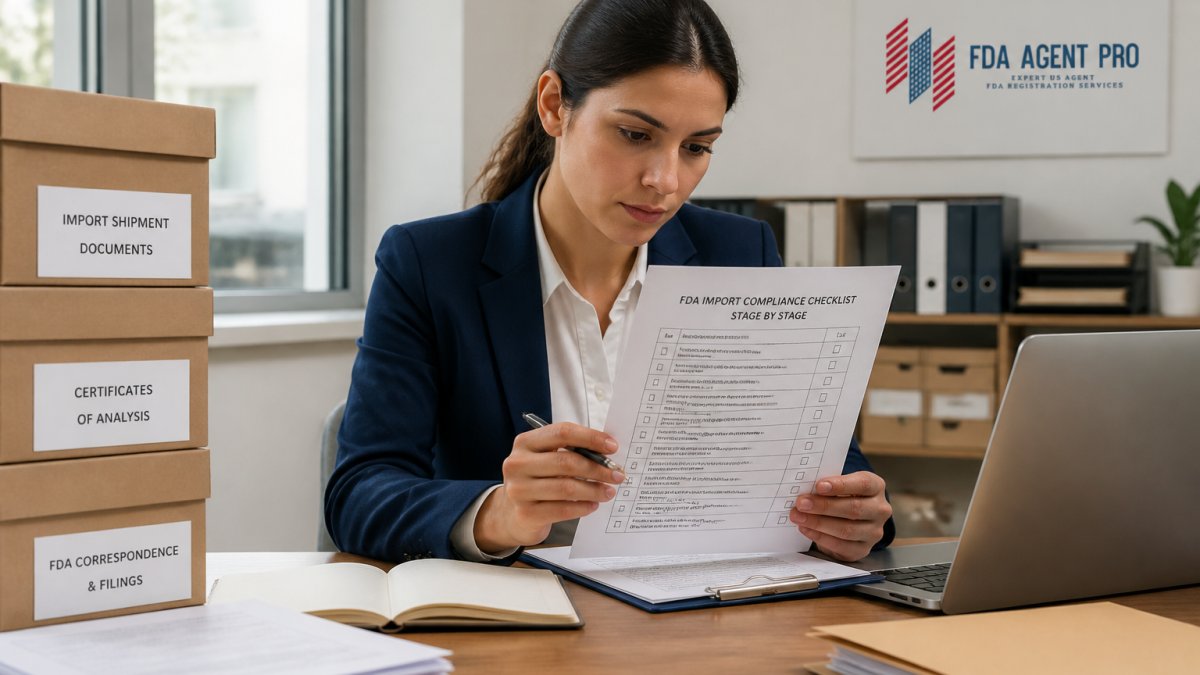
An FDA import compliance checklist works only if it maps to the actual sequence of a shipment. Here is the order we use, from facility setup through customs release.
Stage 1: Facility setup
- Facility registered with the FDA and current
- Unique Facility Identifier on file and matching registration
- U.S. agent appointed and reachable
Stage 2: Pre-shipment
- Product listing or classification confirmed for the product type
- Labeling reviewed against U.S. requirements
- FSVP documentation package assembled for the importer
Stage 3: Shipment
- Prior Notice filed and confirmed before arrival
- Entry filed by broker with accurate product codes
- Commercial invoice and packing list consistent with Prior Notice
Stage 4: Release
- FDA review cleared or examination passed
- Goods released; records retained
Labeling, Packaging, and Product-Specific Requirements
Labeling and packaging requirements change sharply by product type, and a single template fails. Identify your product category before you write a label, because the requirement set, and the premarket pathway, is category-specific. Use the framework below, then confirm specifics against current FDA guidance for that category.
Product-by-product decision framework
Drugs. Human drugs require an approved application (NDA or ANDA) or an applicable exemption, and establishments must register and list.
Cosmetics. Under the Modernization of Cosmetics Regulation Act (MoCRA), cosmetic facilities must register and list products, and the responsible person must maintain adverse event records and safety substantiation.
Other regulated goods. Radiation-emitting products, biologics, and tobacco products each follow separate pathways.
Labeling mechanics that trip up exporters
Three labeling failures recur across categories. First, the label is written for the home market and never adapted to U.S. requirements, missing Nutrition Facts or Supplement Facts, missing allergen declarations, or ingredient names that do not match U.S. nomenclature.
For the cosmetic obligations specifically, the FDA MoCRA cosmetics registration page is the reference point, and FDA Agent Pro manages MoCRA registration for exporters who lack an in-house regulatory team.
FDA Export Certificates: Certificate to Foreign Government and Certificate of Free Sale
FDA export certificates are documents the agency issues to confirm a product's status for a foreign buyer or regulator. The Certificate to Foreign Government certifies that a product is legally marketed in the United States.
The catch: certificates are issued for products that are actually in compliance. If your registration has lapsed or a listing is incomplete, the certificate request stalls.
When a Shipment Is Detained, Refused, or Missing Documents
Detention is a hold for review, not a final refusal, and the difference matters. When the FDA detains a shipment, it issues a notice of detention and gives the filer a window to respond with documentation or request a hearing. Refusal of admission comes after that window closes without resolution and triggers export or destruction of the goods. The outcome depends almost entirely on whether the response is timely and matched to the specific violation cited.
The response sequence
- Read the detention notice and identify the specific violation cited. The notice states the reason for detention, for example, an appearance or labeling issue, a missing or inconsistent Prior Notice, a facility registration mismatch, or a failure to meet an applicable standard. Respond to that issue, not to a general defense.
- Assemble the documentation that answers that violation. If the issue is labeling, provide corrected label artwork and an explanation of the change. If the issue is Prior Notice, provide the confirmation and reconcile the data fields. If the issue is a registration mismatch, provide the current registration and the correct Unique Facility Identifier. If the issue is an FSVP record, coordinate with the importer to supply the verification file.
- Submit the response through the proper channel before the deadline. The response goes through the entry filer or the U.S. agent, depending on the notice, and must arrive before the window closes. Late responses are treated as no response.
- If refused, decide between reconditioning, export, or destruction. Reconditioning requires an approved plan and may involve reinspection. Export returns the goods to the origin or another market. Destruction is the default when neither is feasible.
Missing-document holds
A missing-document hold is different from a substantive detention: the shipment is stopped because a required filing or record is absent or inconsistent, not because the product itself is deficient. Common triggers are an unconfirmed Prior Notice, an entry filed against the wrong product code, a commercial invoice that does not match the Prior Notice data, and a lapsed or mismatched facility registration.
Escalation and prevention
Escalation follows the notice: the filer or U.S. agent responds first, and if the issue is unresolved within the response window, the next step is the hearing request or reconditioning plan. Prevention is cheaper than response. Most holds trace to a small set of preventable errors, mismatched facility identifiers, incomplete labels, inaccurate entry data, and late Prior Notice. Verifying those four items before every shipment removes most of the risk.
Frequently Asked Questions
Does a foreign facility need to register with the FDA?
Yes, if it manufactures, processes, packs, or holds food, drugs, devices, cosmetics, or radiation-emitting products intended for the U.S. market, FDA foreign facility registration is generally required. Food facilities must renew registration biennially and provide a Unique Facility Identifier. Drug, device, and cosmetic establishments have their own registration and listing obligations, and MoCRA added registration duties for cosmetic facilities. Registration is not a one-time task: details must stay current, and missing a renewal can hold up shipments at the border.
What is the Foreign Supplier Verification Program (FSVP)?
FSVP is an FSMA rule that makes the U.S. importer responsible for verifying that its foreign supplier produces food meeting U.S. safety standards. The importer must identify hazards, evaluate the supplier's performance and food safety history, and conduct supplier verification activities such as audits or product testing. Foreign exporters should expect importer requests for documentation and cooperate early. A strong FSVP record on the importer side protects both parties, since entry can be refused when the importer cannot show adequate verification.
How can exporters prevent FDA import delays?
Start with accurate registration and a current U.S. agent, then confirm that Prior Notice is filed for every food shipment and that labels meet FDA labeling requirements before the container leaves. Keep a single document pack, including registration numbers, entry data, and supplier verification records, ready for the broker. Respond to FDA requests within the stated window rather than after the hold is placed. Most delays trace to mismatched facility details, missing Prior Notice, or label errors, all of which are preventable with a pre-shipment review.
What FDA export certificates are available, and when are they needed?
FDA issues export certificates such as the Certificate to Foreign Government and the Certificate of Free Sale for products legally marketed in the U.S. Foreign buyers, tenders, or their own regulators often request one as proof of status. Applications go through FDA's certificate request process, and processing times vary by product type and workload. Plan ahead: a certificate is issued for a specific product and destination, so confirm exactly what the buyer needs before submitting, and keep copies with the shipment documentation.
What FDA labeling requirements should foreign exporters review?
Food labels need an ingredient declaration, nutrition labeling where applicable, allergen statements, net quantity, and the name and place of business of the manufacturer or distributor. Drug, device, and cosmetic labels carry their own mandatory statements, and MoCRA added fragrance allergen disclosure duties for cosmetics. Review labels against the current regulation before printing, not after a detention. Country-of-origin marking is handled separately by U.S. Customs and Border Protection, so check both sets of rules.
How does a foreign exporter find a U.S. FDA agent?
Foreign facilities required to register must designate a U.S. agent who lives or maintains a business in the United States and is available to communicate with FDA. The agent receives FDA correspondence, responds to inspection notices, and helps resolve entry problems. Choose a provider with experience in your product category, not just a mailbox service, and confirm response times in writing. Your agent's details must be accurate in your registration, since FDA uses them as the first point of contact.
A detention notice with a short response window is the moment compliance stops being paperwork and becomes a deadline. FDA Agent Pro acts as your U.S. agent and manages facility registration, product listings, labeling review, and biennial renewals so nothing lapses between shipments. With our team handling the correspondence and the filings, you get a clear answer when the FDA comes calling. Contact us to get your registration and agent coverage in place before your next shipment.